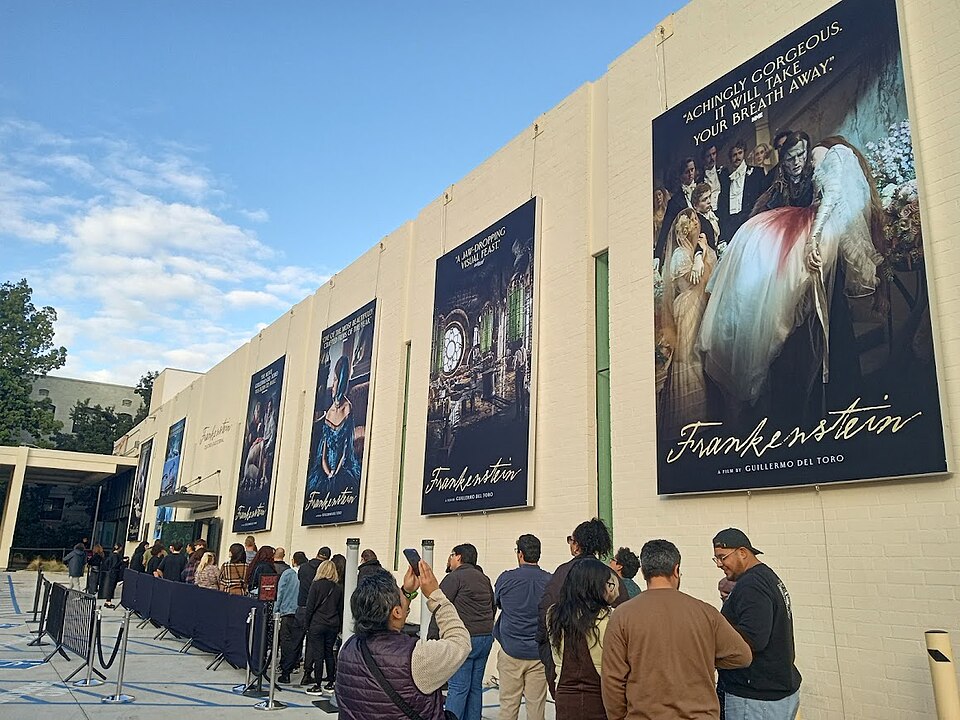
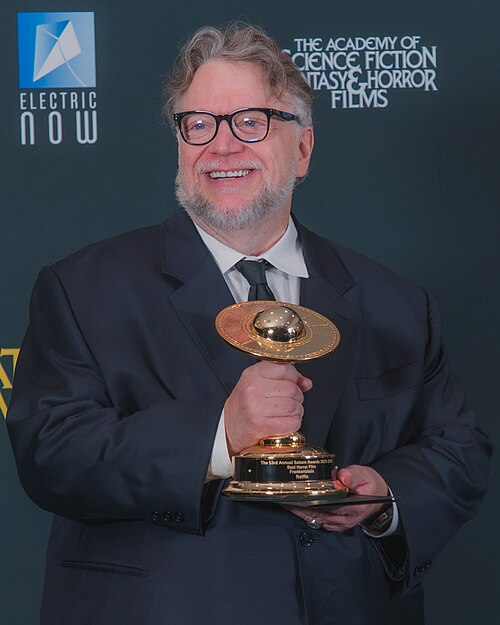
Guillermo del Toro’s most prominent controversial statement regarding his film Frankenstein (2025) occurred during the 2025 Gotham Awards, where he repeatedly declared “Fuck AI” while accepting the Vanguard Tribute alongside stars Oscar Isaac and Jacob Elordi
Guillermo del Toro’s Frankenstein left the 98th Academy Awards with three major craft Oscars, including Best Visual Effects. But in the days that followed, the industry conversation shifted quickly. The focus was no longer on the film’s artistry alone—it was on the tools behind it.
At the center of the discussion: Did AI play a role in building this award-winning film?
A Monster Built by Hand — Or Was It?
The film’s visual scale is undeniable. VFX studio MR.X delivered over 930 shots across 146 sequences, totaling more than 147,000 frames. The work spanned creature design, environment creation, and compositing at a massive level.
Del Toro, however, has been unwavering in his stance:
“AI, particularly generative AI, I am not interested, nor will I ever be interested.”
He has consistently framed Frankenstein as a deeply human project, even shaping the character of Victor Frankenstein as a reflection of what he sees as the hubris of modern tech culture.
Yet the scale of the production raises a question the industry can’t ignore:
Can a film of this complexity truly exist without any form of AI assistance?
The Core Distinction: AI vs Generative AI
-
- AI-assisted tools (already common in VFX):
- Rotoscoping
- Denoising
- Motion tracking
- Color matching
- Generative AI (controversial):
- Creating faces, characters, or environments from prompts
- Replacing or automating creative decisions
- AI-assisted tools (already common in VFX):
The Invisible Layer of Modern VFX
No official statement confirms the use of generative AI in Frankenstein. But industry professionals point out something more subtle:
At this scale, AI-assisted processes are often baked into the pipeline itself.
These tools operate quietly in the background:
- Cleaning up render noise
- Enhancing compositing efficiency
- Automating repetitive technical tasks
They don’t create the art—but they help deliver it faster and cleaner.
The question is no longer whether AI was used.
It’s whether its use is visible—or even acknowledged.
VFX Studios: Quiet Adoption, Rapid Investment
In the wake of the Oscar win, several VFX houses have begun referencing Frankenstein internally as proof that:
“AI-assisted workflows are now part of award-winning pipelines.”
Studios are increasingly investing in:
- Proprietary AI compositing tools
- Procedural environment generation
- Machine learning–based optimization systems
However, public communication remains cautious. The political and creative sensitivity around AI—especially following del Toro’s statements—has made transparency a delicate issue.
A Debate Hollywood Has Been Avoiding
The timing of this conversation is not accidental.
Just days before the Oscars:
- Academy leadership reiterated that AI is a tool, not a creator
- Major directors expressed skepticism about AI replacing human creativity
Yet the reality is more complex.
Even filmmakers who reject AI creatively are working within pipelines that may include machine learning at deeper technical levels—often outside their direct control.
This creates a gray area:
Can a director truly “avoid AI” if it exists several layers below their creative decisions?
- Faster Production Cycles
- Reduced Costs
- Enhanced Realism
- Scalable Content Creation
- Improved Creative Flexibility
The Industry Crossroads
The broader industry is already moving in multiple directions:
- Some projects are experimenting with AI as a primary creative tool, reconstructing lost footage or generating entirely new scenes
- Others insist on preserving human-first creative control, using AI only as support-
Leadership voices are beginning to frame a middle ground:
AI should remain a tool under human direction—not a replacement for it.
But defining where that line sits is becoming increasingly difficult.
Where the Debate Goes Next
Frankenstein’s Oscar win doesn’t prove that AI is replacing artists.
What it does reveal is something more important:
AI is already embedded in the filmmaking process—whether acknowledged or not.
The real question moving forward is not:
- Was AI used?
But:
- Who controls how it’s used?
- At what level does it influence creative authorship?
- And how transparent should that process be?
As AI tools become more powerful and more accessible, filmmakers may demand greater visibility and control over the pipelines shaping their work.
Because in the end, the debate isn’t just technical.
It’s about authorship, ownership, and the future of creativity itself.